How to Choose Amber Glass Bottles for Global Sourcing?
Choosing amber glass bottles for global sourcing involves more than selecting a dark container. The right option must protect contents, survive transit, and fit local market expectations. In practice, buyers compare light protection, glass grade, neck finish, closure compatibility, and total landed cost. A bottle may look excellent in a sample room yet fail after vibration, temperature changes, or rough handling. Small details matter.
Reliable sourcing begins with evidence. Ask manufacturers for material specifications, dimensional drawings, closure test results, and recent quality records. Confirm whether the amber color offers consistent ultraviolet protection across production batches. Check wall thickness, overflow capacity, thread accuracy, and surface defects. Request samples from multiple lots, not one polished sample. That step can expose variation. Independent testing may also verify chemical resistance, leakage performance, and transit durability. Regional packaging requirements, recycling systems, labeling practices, and import documentation should be reviewed with qualified local professionals. Standards differ, and assumptions can become expensive.
This guide presents a practical framework for evaluating amber glass bottles across suppliers and markets. It considers product protection, supplier capability, customization, packaging, inspection, shipping, and cost control. Experience helps, but it is not enough. Even experienced teams miss hidden risks. One test is never enough. A careful comparison records evidence, challenges optimistic claims, and leaves room for corrective action. The goal is not the cheapest bottle. It is a dependable package that performs consistently from the factory floor to the customer’s hand.
Define UV Protection: Amber Glass Blocks Light Below Approximately 450 nm
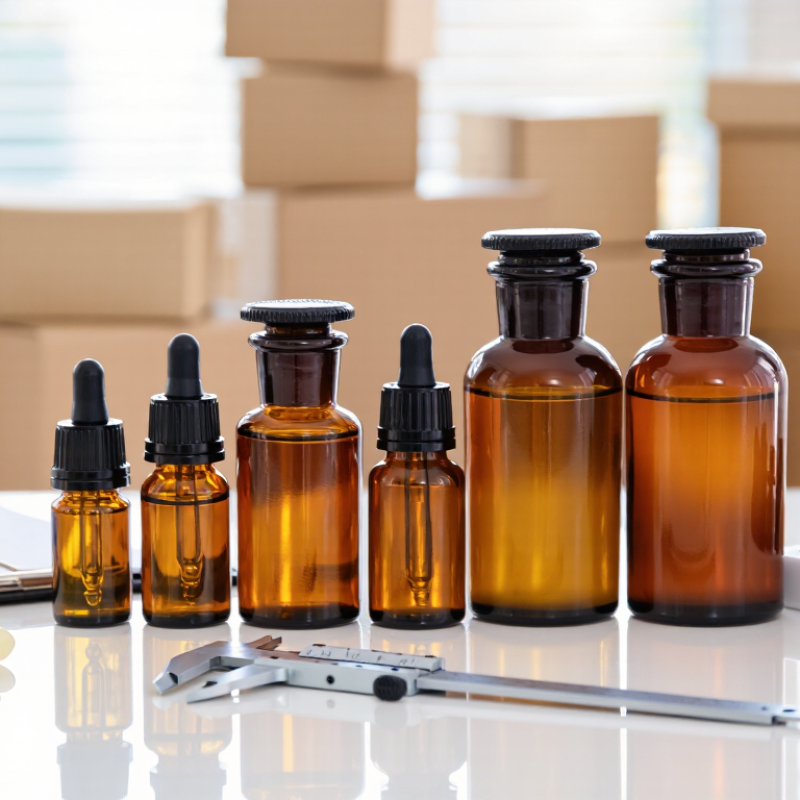
When choosing amber glass bottles for global sourcing, start with their optical protection, not their color alone. Amber glass typically blocks light below approximately 450 nm, including much of the blue and ultraviolet range. This matters for light-sensitive liquids, botanical extracts, and certain laboratory formulations. However, protection varies with glass composition, wall thickness, and manufacturing quality.
Ask suppliers for a measured light-transmission curve. A simple color sample is not enough. In my sourcing experience, two bottles with similar amber shades can perform differently under UV testing. Request data for wavelengths from 300 to 500 nm, and check whether testing used the actual bottle thickness. Thin shoulders or uneven bases may allow more light through. Small details matter.
Check closure compatibility, leakage performance, and surface defects during sampling. Inspect several production lots, not only one approved sample. International shipments can expose bottles to strong sunlight, heat, and vibration. Protective cartons and internal dividers reduce breakage, but they do not improve UV protection. One common mistake is assuming darker glass always means better protection. It may not. Another is trusting a supplier’s general certificate without confirming the exact bottle model. I would also review regional packaging requirements and recycling practices before placing a large order. Perfect data is uncommon, so record the gaps and decide which risks remain acceptable.
Select Glass Type: USP <660> Classifies Containers as Type I, II, or III
For global sourcing, amber color is only the starting point. USP <660> classifies glass by hydrolytic resistance, not by shade. Type I is borosilicate glass with the highest chemical durability. It suits sensitive formulations and demanding storage conditions. Type II is treated soda-lime glass with improved surface resistance. Type III is untreated soda-lime glass and offers moderate resistance. Choose carefully.
The test matters.
USP <660> measures alkali released from the glass during controlled extraction, then evaluates the solution’s acidity. A lower release indicates stronger resistance to chemical attack. In practice, request the supplier’s USP <660> test report, batch certificate, and amber-light transmission data. A 2024 pharmaceutical packaging market assessment valued global glass packaging demand at more than 14 billion U.S. dollars, showing how widely these containers are sourced. IQVIA’s 2024 Global Use of Medicines report also projects global medicine spending to reach 2.3 trillion dollars by 2028. That scale increases pressure for consistent packaging.
Do not select Type III solely because it costs less. For dry powders or stable products, it may be reasonable. For moisture-sensitive or alkaline products, Type I or Type II deserves closer review. Check wall thickness, thermal-shock performance, dimensional tolerances, and closure fit. A practical weakness remains: supplier documents can look complete while omitting actual light-transmission curves. Ask for the raw test data. I would not rely on color alone.
Match Closures and Neck Finishes with ISO 4796 and GPI Standards
Choosing amber glass bottles for global sourcing requires more than matching color and capacity. Amber glass can reduce light exposure, but it does not replace proper storage validation. Start with the bottle’s intended use, fill volume, chemical compatibility, and transport conditions. Humidity, temperature changes, and rough handling can expose weak packaging choices.
ISO 4796-1 helps define screw-neck bottle dimensions, including the neck finish and functional fit. GPI standards provide another useful reference for finish dimensions and closure compatibility. Match the bottle finish with the correct cap, liner, and sealing system. Do not assume that two closures with similar threads will perform equally. Check drawings, thread details, torque ranges, and liner contact areas. A small mismatch may cause leakage or difficult opening.
Request dimensional inspection records from the supplier. Verify the neck finish with gauges when possible. Test filled samples under vibration, inversion, and temperature cycling. The closure material also matters, especially with oils, solvents, or moisture-sensitive contents. A liner that seals well in the factory may behave differently after long-distance shipping. This is an easy point to overlook.
Sourcing teams should also confirm whether the supplier uses ISO-based inspection methods or only internal specifications. Standards improve communication, but they do not remove the need for application testing. I would avoid approving a bottle from a drawing alone. Real samples often reveal uneven threads, brittle glass, or excessive closure torque. Small defects become expensive across international shipments.
How to Choose Amber Glass Bottles for Global Sourcing?
Match Closures and Neck Finishes with ISO 4796 and GPI Standards
The chart compares nominal neck diameters used in common GPI finish designations. The first number in a designation, such as 28 in 28-410, represents the nominal neck diameter in millimeters; the second number identifies the finish series. ISO 4796 should be used to verify the glass container dimensions, tolerances, and neck details, while the GPI finish designation helps match the bottle with the correct closure. Always confirm the supplier’s technical drawing before global sourcing.
Validate Compliance with USP <660>, Ph. Eur. 3.2.1, and ISO 15378
How to Choose Amber Glass Bottles for Global Sourcing?
Validate Compliance with USP <660>, Ph. Eur. 3.2.1, and ISO 15378
Amber glass can reduce light exposure, but color alone does not prove pharmaceutical suitability. For global sourcing, request the exact glass composition, manufacturing site, and intended container use. USP <660> evaluates glass containers through hydrolytic resistance testing. Ph. Eur. 3.2.1 addresses glass quality, surface performance, and container suitability. These references support comparison, not automatic approval.
ISO 15378 adds GMP-based controls for primary packaging manufacturers. Ask for a current certificate, scope, audit history, batch records, and change-notification procedure. Verify that the certificate covers the actual site and product family. Request recent test reports, sampling plans, and traceability from furnace to shipment. Check dimensions, wall thickness, closure fit, visual defects, and light transmission. A supplier may pass one test while process variation remains hidden. That risk deserves attention.
Before ordering, approve representative samples under your filling, sterilization, and transport conditions. Compare results against your product stability requirements, not only a supplier specification. Confirm packaging cleanliness and contamination controls through documented procedures. Keep retained samples and define acceptance criteria before production. No checklist is perfect. I would not rely on a certificate copied into a quotation. Documents can be outdated. Recheck them. A small pilot order can reveal chips, uneven color, or closure mismatch before a global shipment. This is slower, but often cheaper than a rejected batch.
Audit Suppliers Using ISO 2859-1 Sampling and Defined AQL Limits
How to Choose Amber Glass Bottles for Global Sourcing?
Audit Suppliers Using ISO 2859-1 Sampling and Defined AQL Limits
A reliable amber glass audit begins with a written inspection plan. Define the lot, inspection level, defect classes, and AQL limits before production starts. ISO 2859-1 can determine the sample size from the lot quantity and selected inspection level. Use a random sample across pallets, cartons, and production times. Do not inspect only the top cartons.
Measure the neck finish, height, diameter, wall thickness, and bottle weight. Check amber color under consistent lighting. Inspect scratches, bubbles, stones, cracks, uneven glass, and contamination. Measure leakage with the intended closure, not a substitute cap. Verify label position, carton dividers, and pallet stability. Measure the neck.
Classify defects as critical, major, or minor, then assign separate AQL values. A critical defect may require zero acceptance, while major and minor limits depend on product risk and customer requirements. Record the sample code, carton numbers, gauge calibration, photographs, and inspector names. Keep evidence.
AQL is not a promise that every bottle is perfect. It is a sampling decision rule, not a production target. In practical audits, I have seen acceptable averages hide one damaged carton. That weakness deserves investigation. Recheck the supplier’s process controls, glass batch records, mold maintenance, and final inspection logs. Supplier approval should also consider corrective-action speed, traceability, and whether repeated results remain stable over several lots.